Home / Blog / How to Calculate Solar Irradiance
How to Calculate Solar Irradiance
If you want to know how to calculate solar irradiance, start with the units. Solar irradiance is the power of sunlight falling on a square metre, measured in watts per square metre (W/m2). Add that power up over time and you get irradiation, the energy per square metre, measured in kilowatt-hours per square metre (kWh/m2). The calculation is a chain, from the sunlight above the atmosphere to a total over a day or a year.
The short answer is this. Take the annual irradiation for your roof plane in kWh/m2, divide it by 1,000 W/m2 to get peak sun hours, and multiply by the size of your system in kWp and by a performance ratio of roughly 0.75 to 0.80 to allow for real losses. That gives the expected annual output in kWh.
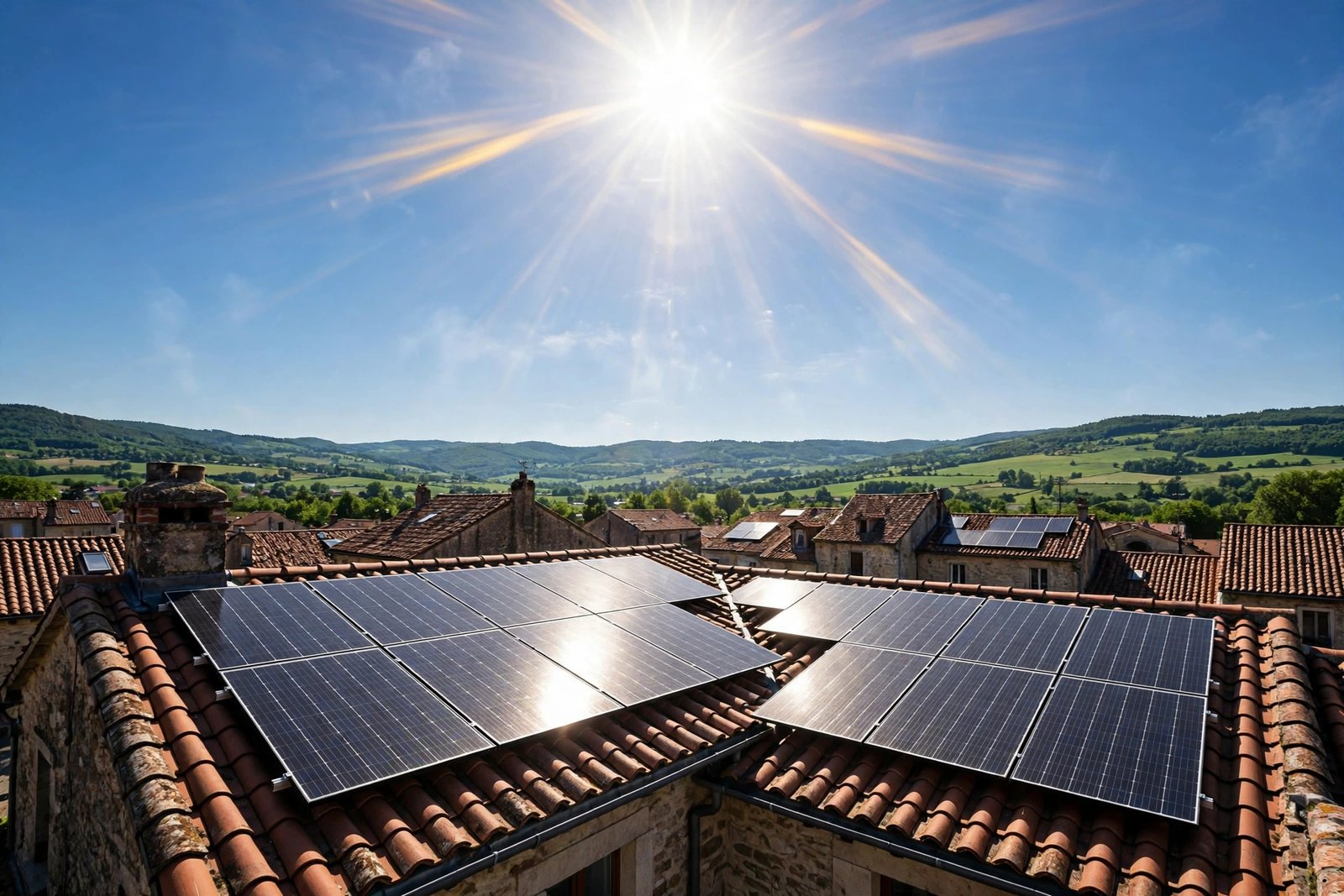
Irradiance and irradiation are not the same thing
Irradiance is power, here and now. At any moment, the sun delivers a certain number of watts to each square metre of surface, and that number is the irradiance, written G and measured in W/m2. It changes all day: low in the morning, high around noon, low again in the evening, and near zero at night. Irradiation is energy, added up over time, measured in kWh/m2 over a day, a month or a year.
Confusing the two breaks every calculation that follows. A panel rated at 400 Wp produces that power only when the irradiance on its surface is 1,000 W/m2 under standard test conditions, with a cell temperature of 25 degrees Celsius. To know what the panel makes in a day, you need the irradiance added up hour by hour, which is the daily irradiation. Use a noon figure as a daily average and you will overstate the yield.
The three parts of sunlight that reach a panel
Sunlight does not arrive at a panel as one simple beam. It arrives in three parts, and a panel collects all three. Direct sunlight travels in a straight line from the sun. Diffuse sunlight has been scattered by air, water vapour and clouds, and it arrives from all directions at once, which is why a panel still produces on a cloudy day. Reflected sunlight bounces off the ground and reaches the panel from below.
On a flat surface, the total is called global horizontal irradiance, shortened to GHI. It is the sum of direct sunlight on the horizontal plane and diffuse sunlight from the sky above it, the figure weather stations and satellite datasets report. Panels, however, are rarely flat. They sit tilted, facing a chosen direction, so what matters for a roof is the total on the tilted plane, called global tilted irradiance, or GTI. The tilt changes all three parts at once: it turns the panel more squarely toward the direct sun, it sees less sky and catches more reflected light.
That is why a flat figure cannot be used directly for a tilted roof. A roof facing south and tilted at a moderate angle receives more sunlight over the year than the same roof laid flat, because it meets the low winter sun more squarely. East and west roofs still collect a useful total, but their direct light arrives earlier or later in the day. Any honest calculation starts from GHI and converts it to GTI for the actual roof.
How to calculate solar irradiance, step by step
Step 1 is the solar constant. Above the atmosphere, the sun delivers about 1,361 W/m2 to a surface facing it directly. That figure is a starting point only, because no panel sits above the atmosphere. It explains the 1,000 W/m2 used in panel ratings.
Step 2 is what the atmosphere takes away. Air, water vapour, dust and cloud scatter and absorb sunlight before it reaches the ground, and the longer the path through the air, the more is lost. That is why the sun is weaker in the morning and evening, and stronger around noon. Clouds add the biggest variation: a thin cloud trims the direct beam a little, while a thick cloud can cut it to a small share and leave mostly diffuse light.
Step 3 is the move from horizontal to tilted. Take the GHI for your place and the share of it that is direct and diffuse, then work out how much of each part lands on a plane tilted at your roof angle and facing your roof direction. The direct part depends on the angle between the sun and the panel, which changes through the day and the year. Do this for every hour of a typical year and add the results to get the annual irradiation on the tilted plane, in kWh/m2.
Step 4 is peak sun hours. Divide the daily irradiation in kWh/m2 by 1,000 W/m2, which is 1 kW/m2, and the result is the number of peak sun hours for that day. A day with 4.8 kWh/m2 of irradiation has 4.8 peak sun hours. Peak sun hours are the bridge to output: a 1 kWp system makes about 1 kWh for each peak sun hour before losses.
Worked example: Milan, Madrid and Kassel
Here is the whole chain with real figures, read from the Sun Index solar irradiance calculator on 14 November 2026. The calculator gives the annual irradiation on a tilted plane for each city, using PVGIS SARAH3 data. The table shows that irradiation, the peak sun hours it implies, and the output it gives for a 5 kWp system. See our methodology for the method.
| City | Annual irradiation (kWh/m2) | Peak sun hours per day | Specific yield (kWh/kWp) | Expected output, 5 kWp (kWh per year) |
|---|---|---|---|---|
| Milan | 1,760 | 4.8 | 1,365 | 6,824 |
| Madrid | 2,085 | 5.7 | 1,610 | 8,052 |
| Kassel | 1,268 | 3.5 | 1,016 | 5,079 |
Source: PVGIS SARAH3 data via the Sun Index solar irradiance calculator
Check the arithmetic for Milan. Annual irradiation of 1,760 kWh/m2 divided by 1,000 W/m2 gives 1,760 peak sun hours for the year, or 4.8 per day on average. A 5 kWp system makes 1,760 times 5, which is 8,800 kWh, before losses. The expected output in the table is 6,824 kWh, about 78 percent of that ideal figure. It matches the calculator: 6,824 divided by 5 is 1,364.8 kWh/kWp, rounded to 1,365. Madrid and Kassel follow the same pattern, at about 77 and 80 percent of ideal.
The honest shortcut: let satellites do the sums
The honest shortcut is to stop calculating by hand once you understand the chain. Satellites and ground stations have already measured the sunlight for your place, hour by hour, over many years, and PVGIS turns those measurements into irradiation for any tilt and direction. That is what the official PVGIS tool does for any location in Europe and beyond. Nobody should size a real roof by hand from the solar constant. The monthly yield page shows the spread through the year, and the solar calculator turns output into savings.
Common mistakes when you calculate solar irradiance
Treating noon irradiance as an average. A clear noon reading near 1,000 W/m2 is the peak of the day, not the day itself. The daily irradiation is the area under the whole curve, morning to evening.
Mixing the two units. Irradiance in W/m2 and irradiation in kWh/m2 are not interchangeable. Check the unit on every figure before you use it, and check it again before you multiply.
Ignoring tilt. A flat irradiation figure belongs to a flat surface. Use it for a tilted roof without converting GHI to GTI and you will understate a south-facing roof and misjudge an east or west facing one.
Judging by one day. A single bright day in June says nothing about a year, and a single grey day in December says nothing either. Size a system on annual irradiation.
Frequently asked questions
What is the formula for solar irradiance?
There is no single formula that gives the irradiance on your roof. The working method is a chain: start from the solar constant of about 1,361 W/m2, subtract the losses in the atmosphere, correct for tilt and direction, and add the values up to get irradiation in kWh/m2.
What is the difference between irradiance and irradiation?
Irradiance is power at a moment, measured in W/m2. Irradiation is energy added up over time, measured in kWh/m2. A panel is rated by irradiance at 1,000 W/m2, but its yearly output is planned from irradiation.
What are peak sun hours?
Peak sun hours are the daily or annual irradiation divided by 1,000 W/m2. A day with 4.8 kWh/m2 has 4.8 peak sun hours.
What is a good solar irradiance for solar panels?
For panels, what matters is the annual irradiation on the tilted plane, not a single noon reading. In the worked example, Madrid receives 2,085 kWh/m2 a year, Milan 1,760 and Kassel 1,268.
Do I need to calculate irradiance myself before getting panels?
No. Understand the chain so you can read a quote, then let the Sun Index solar irradiance calculator or the official PVGIS tool do the sums for your roof. An installer should still confirm the tilt, direction and shading on site.
Once you can tell irradiance from irradiation, a solar quote becomes much easier to read. You can read more in the Sun Index Blog, and if winter performance worries you, start with our guide to solar panels in winter.