Home / Blog / Do Solar Panels Work on Cloudy Days?
Do Solar Panels Work on Cloudy Days?
Yes, solar panels work on cloudy days. They do not switch off when the sun goes behind a cloud, they slow down. A panel makes electricity from daylight, not from direct sunshine alone, and clouds scatter daylight rather than blocking it outright. The honest question is not whether panels work under cloud, but how much less they make, and whether that smaller output still pays. On a heavily overcast day a system makes roughly 10 to 25 percent of what it makes on a clear day, according to EnergySage, and the Sun Index calculators put the same range in kilowatt hours: a 5 kWp system in Milan makes about 30 kWh on a clear July day and about 8 kWh on an overcast one. This guide puts numbers on every kind of grey sky, explains the diffuse light that keeps panels going, names the one surprise upside of cloud, and works out what cloudy days mean for the money, with every yield figure read from the Sun Index tools and from PVGIS.
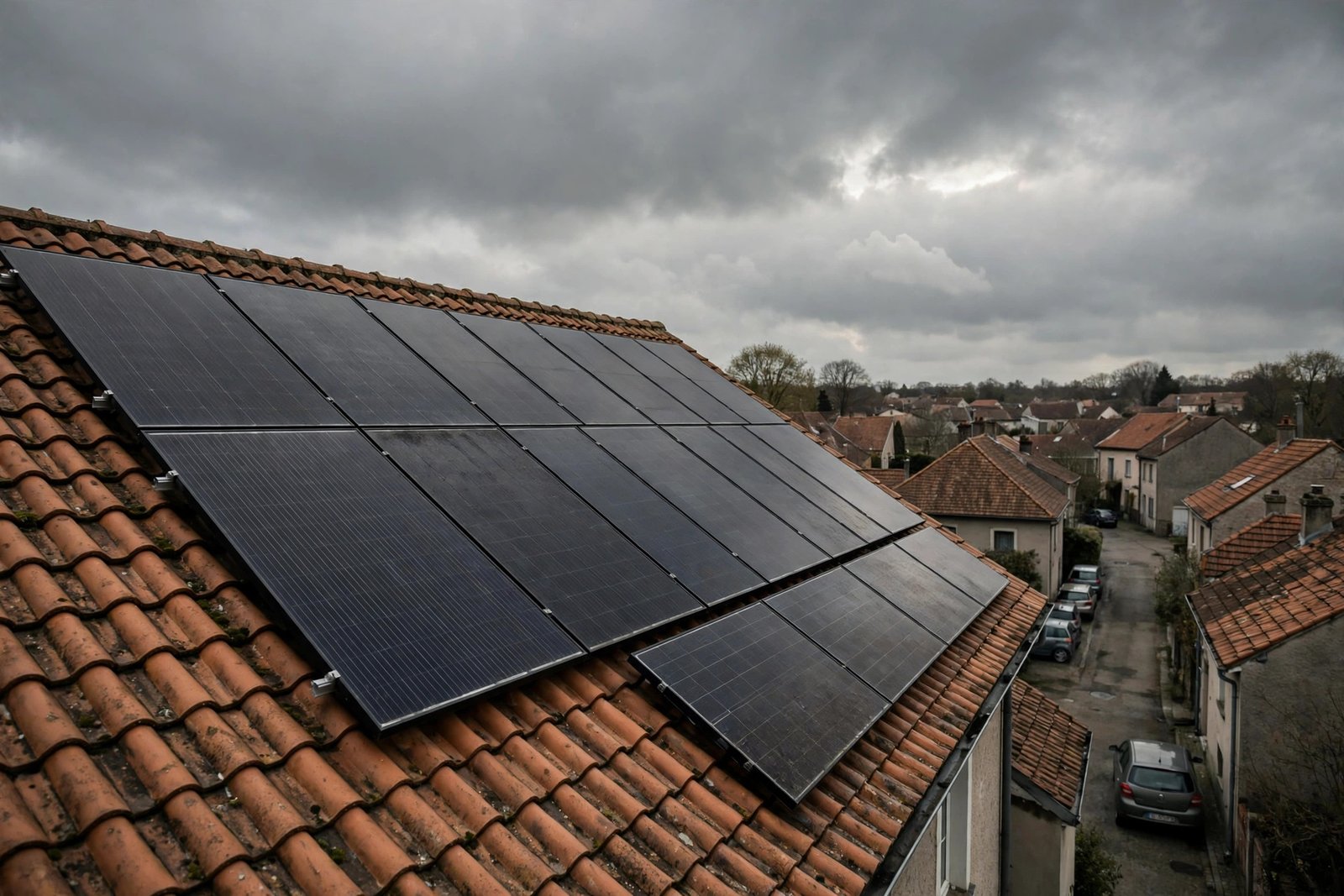
Grey sky, working panels: the roof above is making roughly a quarter of its clear-day output under this cloud, and it is still making electricity.
The short answer: yes, at 10 to 25 percent on a heavy overcast day
EnergySage, which tracks the panels it sells in the United States, puts it plainly: on cloudy days solar panels still generate 10 to 25 percent of their normal power output, and its key takeaways put the typical figure at 10 to 15 percent. The range is wide because cloud is not one thing. A thin high haze barely dents production, a bright white overcast sky still lets through a good share of the light, and a dark rain cloud cuts it to the bottom of the range. What matters is how thick the cloud is, not whether the sky is cloudy at all.
The Sun Index daily yield calculator says the same thing in the numbers for one real roof. A 5 kWp system in Milan averages 28.3 kWh a day in July, but the tool warns that a real July day in Milan can deliver 30 kWh or 8 kWh depending on cloud, and that a single overcast day can cut output by 70 percent or more. The 8 kWh day is about 27 percent of the 30 kWh day, right at the bright end of the EnergySage range, which is what you would expect: a Milan July overcast day still has fifteen hours of daylight behind the cloud, so even a grey day there carries real energy.
Two things follow from the short answer. First, no single cloudy day decides whether solar is worth it, because the annual figures the solar calculator works from already contain every cloudy day of the year. Milan's locked PVGIS anchor of 6,824 kWh a year for a 5 kWp system is a long-term average built from real weather, grey days included. Second, the question that actually matters for a buyer is not the worst day but the shape of the year: how much of the annual total falls in the grey months, and how a system is sized for them. The tables below answer both.
What a cloudy day costs in kilowatt hours
The table below takes the daily yield tool's own July figures for Milan and sets them side by side. The clear day and the overcast day are both July days on the same roof, so the difference is the cloud alone, not the season.
| Sky in Milan, July, 5 kWp | Production | Share of a clear day |
|---|---|---|
| Clear day | about 30 kWh | 100% |
| Average July day | 28.3 kWh | about 94% |
| Overcast day | about 8 kWh | about 27% |
Source: Sun Index daily yield calculator, Milan, 5 kWp, checked 27 November 2026. The average July day sits close to the clear day because most July days in Milan are clear; the overcast figure is the tool's own warning that a real July day can fall to 8 kWh. The 10 to 25 percent range from EnergySage, updated June 2026, covers heavier cloud than a typical Milan July overcast day.
Put a price on those two days and the gap looks smaller than the percentages suggest. The solar calculator values a Milan 5 kWp system at EUR 1,071 of saving a year against 6,824 kWh generated, which works out at about EUR 0.16 per generated kilowatt hour on average. At that average value a clear July day is worth about EUR 4.70 and an overcast one about EUR 1.25. A full week of overcast July days makes about 56 kWh against about 210 kWh for a clear week, a shortfall of about 154 kWh, or about EUR 24 at the same average value. Real money, but not a disaster: one grey week in July costs roughly what two clear days earn.
The year as a whole is where cloud shows up properly, and the seasonal split is the table to remember. The monthly yield tool gives Milan 6,824 kWh a year, split as follows:
| Season, Milan 5 kWp | Production | Share of the year |
|---|---|---|
| December to February | 891 kWh | 13% |
| March to May | 2,148 kWh | 31% |
| June to August | 2,528 kWh | 37% |
| September to November | 1,258 kWh | 18% |
Source: Sun Index monthly yield calculator, Milan, 5 kWp, PVGIS SARAH3, checked 27 November 2026. The three winter months together make 891 kWh, little more than a single good summer month: July alone makes 878 kWh. November is the weakest month of all at 223 kWh, below December's 236 kWh, because Milan's November skies are cloudier than its December skies even though December has the shortest days. That is cloud, not geometry, deciding the weakest month, and it is the clearest proof in the site's own data that cloud cover moves real numbers.
Why panels keep working under cloud: diffuse light
Sunlight reaches a roof in two forms. Direct light travels in a straight line from the sun, and it is the part that casts a sharp shadow. Diffuse light has been scattered by air molecules and by cloud droplets, and it arrives from every direction at once, which is why the sky is bright on an overcast day even though the sun itself is invisible. A solar panel converts both. The silicon cell does not know or care whether a photon came straight from the sun or bounced off a cloud on the way; it responds to light hitting the cell, and diffuse light still hits the cell.
That is why output falls but never reaches zero while there is daylight. On a heavily overcast day the direct part is nearly gone and the panel runs on diffuse light alone, which is the 10 to 25 percent of the EnergySage range. On a lightly cloudy day the direct part is only partly cut, and the panel keeps most of its output. The winter guide on this blog, Solar Panels in Winter, makes the same point from the seasonal side: winter production is dominated by diffuse light because the sun stays low and the sky is cloudier, and a Milan system still makes 236 kWh in December, which is 3.5 percent of the year from the darkest month.
The share of diffuse light is also why panel choice matters a little more in grey climates than in sunny ones. The comparison on this blog, Monocrystalline vs Polycrystalline Solar Panels, covers how the two types differ, and the practical point for cloudy roofs is that monocrystalline panels hold their efficiency better in low light. The difference is small next to the size of the system and the price of electricity, but on a roof that spends half the year under cloud it is worth having in the comparison. The solar irradiance calculator gives the underlying number for any city: Milan receives about 1,760 kWh per square metre a year on a south-facing roof at the best tilt, and that figure already includes every cloudy day in the long-term average.
The surprise upside: clouds cool the panels
Cloud has one genuine benefit, and it partly offsets the lost light. Solar panels lose output as they heat up: every degree of cell temperature above 25 degrees costs about 0.38 percent of output for a typical crystalline panel. On a bright summer day the cells run far hotter than the air, so the sunniest hours are also the hours when the panels are at their least efficient. Cloud cuts the light, but it also cuts the heat, and the cooler cells convert the light they do get more efficiently.
The Sun Index temperature loss calculator shows the trade directly, for a 450 W panel in 30 degree air:
| Sun strength | Cell temperature | Heat loss | Panel output |
|---|---|---|---|
| 1,000 W/m2, full sun | 61.3 C | -13.8% | 388 W |
| 800 W/m2, bright | 55.0 C | -11.4% | 319 W |
| 600 W/m2, hazy | 48.8 C | -9.0% | 246 W |
| 400 W/m2, overcast | 42.5 C | -6.7% | 168 W |
Source: Sun Index temperature loss calculator, 30 degree air temperature, checked 27 November 2026. Read the table as a trade: the overcast row loses 7.1 percentage points less to heat than the full-sun row, because its cells run nearly 19 degrees cooler. The light loss from the cloud is far bigger than that gain, so an overcast day still makes much less in total, but the heat saving is real and it is one reason a cloudy climate loses less than the sunshine figures alone suggest. The same maths runs in reverse on cold bright days, when cells below 25 degrees beat their rated output, which is why crisp winter mornings can surprise owners watching their app.
The cooling effect also explains a counterintuitive result that owners in hot climates notice: the best production days are often clear and cool, not clear and hot. A heatwave case on the same calculator, 35 degree air under full sun, pushes cells to 66.3 degrees and costs 15.7 percent of output. Mild, bright, breezy weather beats scorching sun, and a cloudy spell in a heatwave can leave the panels working closer to their rating than the blazing days either side of it.
The cloud edge effect: brief spikes above clear-sky output
There is one more quirk worth knowing, because it alarms owners who see it on their monitoring app. On a partly cloudy day, when the sun sits just beside the bright edge of a puffy cumulus cloud, the panels can briefly receive direct sunlight plus extra light reflected off the cloud edge at the same time. EnergySage notes that a cloud can reflect or even magnify sunlight, increasing the power output of the panels, and owners sometimes see their system spike above its clear-sky output for a few minutes.
This is the cloud edge effect, and it is harmless. The spike lasts minutes, the inverter handles it, and the extra energy is a small bonus, not a fault and not a sign that the panels are overperforming in any lasting way. It is also a useful reminder of how the numbers in this guide should be read: the 10 to 25 percent range describes steady overcast, not a day of broken cloud, where output swings between near-clear and deep shade minute by minute and the daily total lands somewhere in between. Judge a system over months, not over one dramatic afternoon, which is exactly what the daily yield tool's own guidance says.
Rain, fog and snow: what each one does
Cloud is not the only grey weather, and the three others behave differently. Rain does not stop panels: a rainy day is an overcast day with water falling through it, so output sits in the same low band as heavy cloud, and the rain itself does useful work. The cleaning guide on this blog, How to Clean Solar Panels, shows that rain washes most of the dust off a roof, so a rainy spell often ends with cleaner panels making slightly more on the next clear day than they did before the rain. Fog is heavier: a thick fog is a cloud at ground level, and output falls to the bottom of the overcast range until it lifts, usually by late morning.
Snow is the one case where output can genuinely reach zero, and only while the panels are covered. A panel under snow makes nothing, because no light reaches the cells at all. The difference from cloud is that snow sits on the panel rather than in the sky, and it slides off a tilted roof as it melts, often in a single sheet. The winter guide covers snow in full, including why a steep tilt sheds it faster. The practical point for cloudy days is the opposite: cloud never covers the panel, so cloud never takes output to zero. As long as there is daylight, there is some production.
Cloudy countries prove the point: Germany
If cloud made solar pointless, Germany would have no solar industry, and it has one of the largest in the world. Germany is among the countries with the least sunshine hours in Europe, yet its solar panels generated 72.2 TWh of electricity in 2024, about 14 percent of the country's total electricity, according to Fraunhofer ISE, reported by pv magazine in January 2025. The country installed 16.2 GW of new solar in that same year, taking total capacity to 99.3 GW by the end of December 2024, according to the Federal Network Agency. Clean Energy Wire puts the lesson in one line: despite being among the countries with the least sunshine hours, Germany is one of the largest solar power producers in the world.
The site's own anchors show the same lesson city by city. Kassel, in central Germany, is the cloudiest of the three locked anchor cities, and its 5 kWp system still makes 5,079 kWh a year, against 6,824 kWh in Milan. The gap is real, about a quarter less, but the Kassel system is far from useless: its strongest month, June, makes 668 kWh, and even its weakest month, December, makes 120 kWh.
| City, 5 kWp south-facing | Annual yield | Weakest month | Strongest month |
|---|---|---|---|
| Milan | 6,824 kWh | November, 223 kWh | July, 878 kWh |
| Kassel | 5,079 kWh | December, 120 kWh | June, 668 kWh |
Source: Sun Index monthly yield calculator, PVGIS SARAH3, checked 27 November 2026. Madrid, the sunniest anchor at 8,052 kWh a year, sits at the other end of the same scale. The spread from Kassel to Madrid is about 58 percent, which is the whole range European cloud creates between a grey northern city and a sunny southern one, and every city in between earns its keep.
EnergySage makes the same point for the United States: San Francisco, famous for its fog, and rainy Seattle both rank among the top solar markets in the country. The reason in both continents is the same, and it is not the weather. High electricity prices matter more than sunny weather when it comes to solar savings, because every kilowatt hour a panel makes is worth the retail price it replaces. A cloudy city with expensive electricity can pay a system back faster than a sunny city with cheap electricity, which is why the solar calculator asks for the price on your own bill before it talks about payback.
What to do about cloudy days
Nothing in this guide calls for special equipment, but three habits make grey weather cheaper to live with. The first is sizing for your climate, not for a brochure. The solar calculator uses your city's own PVGIS yield, so a Kassel roof gets a Kassel answer, and in a cloudier region that usually means installing a few more panels to hit the same annual target. The panel output tool shows what each panel contributes day by day, and the peak sun hours calculator turns your city's light into the planning number installers actually use.
The second is a battery, sized for the day rather than the week. A battery stores the surplus of a good day for the evening, and on a cloudy day it holds the smaller surplus for the hours after dark, which is genuinely useful. What it cannot do is carry a household through a grey week: no home battery size bridges a seasonal gap, as the daily yield tool says plainly. The site's guidance is roughly 1 kWh of storage per kWp of panels, and the battery sizing tool models the pairing against your own consumption, so the battery is bought for the evenings it will actually serve.
The third is the monitoring habit, which is also the cheapest fault detector you own. Check the output against the calculator every few weeks, comparing the same month with the same month last year rather than one day with the next. A system that tracks its monthly figure is healthy; a system that falls steadily behind it has a fault, shading, soiling or an inverter problem, and the cleaning guide and the winter guide both cover the checks to run before calling an installer. Cloud makes daily output jump around, which is normal. A monthly shortfall that does not come back with the sun is not.
One last practical note: do not clean panels because it rained. Rain does the washing, and the cleaning guide's rule stands, that water and a soft brush are enough when cleaning is ever needed, and walking on panels is never worth it. A grey week is not a dirty-panel week, and the output will return with the weather.
Do solar panels work on cloudy days: Frequently asked questions
Do solar panels work on cloudy days?
Yes. Solar panels make electricity from daylight, including the diffuse light scattered by clouds, so they keep producing on cloudy days at reduced output. On a heavily overcast day expect roughly 10 to 25 percent of clear-day output, according to EnergySage, and the Sun Index daily yield calculator puts a Milan overcast July day at about 8 kWh against about 30 kWh on a clear day.
How much power do solar panels produce on a cloudy day?
It depends on how thick the cloud is. A lightly cloudy day barely dents output, a bright overcast day keeps a good share of it, and a dark, heavily overcast day drops output to about 10 to 25 percent of normal, according to EnergySage. For a 5 kWp system in Milan that means about 8 kWh on an overcast July day, against about 30 kWh on a clear one, from the Sun Index daily yield calculator.
Do solar panels work in the rain?
Yes, at the same low output as a heavily overcast day, because a rainy sky is a cloudy sky. Rain does not damage panels, and it washes dust off them, so a rainy spell often ends with cleaner panels making slightly more on the next clear day. Output only reaches zero when panels are covered, by snow, not by rain.
Do solar panels work on cloudy days in winter?
Yes, and winter is when diffuse light matters most, because the sun stays low and the sky is cloudier. A 5 kWp system in Milan makes 891 kWh across December, January and February, about 13 percent of its 6,824 kWh year, from the Sun Index monthly yield calculator. November is the weakest month at 223 kWh, because Milan's November skies are cloudier than December's.
Is solar worth it in a cloudy country?
Yes. Germany is among the least sunny countries in Europe and still generated 72.2 TWh from solar in 2024, about 14 percent of its electricity, according to Fraunhofer ISE. A 5 kWp system in Kassel makes 5,079 kWh a year, against 6,824 kWh in Milan. High electricity prices matter more than sunshine for the payback, because every kilowatt hour a panel makes replaces one bought at the retail price.
Do I need a battery for cloudy days?
A battery helps on cloudy days but does not solve them. It stores the smaller surplus of a grey day for the evening, which is useful, but no home battery carries a household through a grey week or a dark season. The Sun Index guidance is roughly 1 kWh of storage per kWp of panels; the battery sizing tool models the pairing against your own consumption.
The number to carry away is 10 to 25 percent. That is what a heavily overcast day gives you, and it is enough to matter: a Milan system still makes about 8 kWh on a grey July day, Germany runs 14 percent of its electricity on solar under some of Europe's greyest skies, and every cloudy day is already inside the annual figures the calculators quote. Size the system for your city's real weather, keep a battery for the evenings, and judge the roof by the month, not by the afternoon. If you want to see what your own roof should be making on a grey day and a bright one, start with the daily yield calculator and the monthly yield calculator, and come back to the Sun Index Blog for the next guide.
Sources: cloudy-day output of 10 to 25 percent of normal, and typically 10 to 15 percent, from EnergySage, "Do Solar Panels Work at Night or On Cloudy Days?", updated 12 June 2026; Germany's 72.2 TWh of solar generation in 2024, 14 percent of total electricity, and 16.2 GW installed, from Fraunhofer ISE via pv magazine, 3 January 2025, and the least-sunshine characterisation from Clean Energy Wire; yield, saving and temperature figures from the Sun Index daily yield, monthly yield, solar system and temperature loss calculators, Milan and Kassel, 5 kWp, PVGIS SARAH3, checked 27 November 2026; yield figures also checked against the official PVGIS tool.